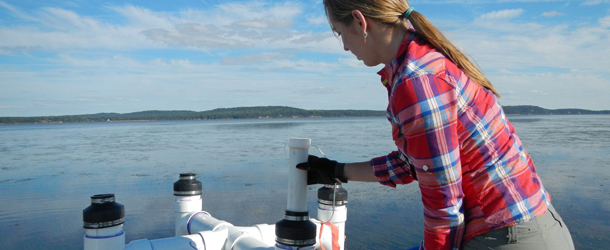
Nina Santos is a Ph.D. student at the Chesapeake Biological Laboratory at the University of Maryland Center for Environmental Science. For her dissertation, she is focused on small shrimp-like crustaceans called mysids – an understudied yet important part of many estuarine and coastal food webs.
Fellowship Experiences
A blog by and about students supported by Maryland Sea Grant
Photo, Debbie Hinkle

From the Lab Bench to Capitol Hill: A Scientist’s Journey Through Congress
Abdulmajid Alrefaie •
You might think there are few parallels between the science conducted in a molecular biology lab and the lawmaking that happens on Capitol Hill. But one of the surprises of my time in Washington, DC, is that it felt less like a career change and more like stepping into a new ecosystem with a different set of instruments. Read more...

Lessons in Supporting the Bay’s Next Seven Generations
Ebram Victoria •
The next generation of environmentalists is an interdisciplinary coalition of ecologists, biologists, geologists, hydrologists, engineers, and designers of the built environment, all committed to the protection and preservation of natural resources. Together, they combat the hard lessons of natural resource exhaustion. Read more...

The Power of Illustration in Scientific Communication
Talia Mastalski •
From childhood wonderment to professional research, every level of learning benefits from factual and thoughtfully designed scientific illustration. Read more...

Bridging the Gap Between Applied and Pure Science in Environmental Toxicology
Sabine Malik •
As an aspiring scientist, I have seen my work evolve to include aspects of pure and applied science, and I have grown to equally appreciate them both. Read more...
Reconnecting with Urban Rivers
Sabine Malik •
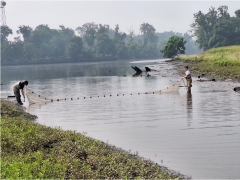
Despite the harsh environmental conditions, the mummichog is not the only creature we find in the Anacostia. Read more...
